
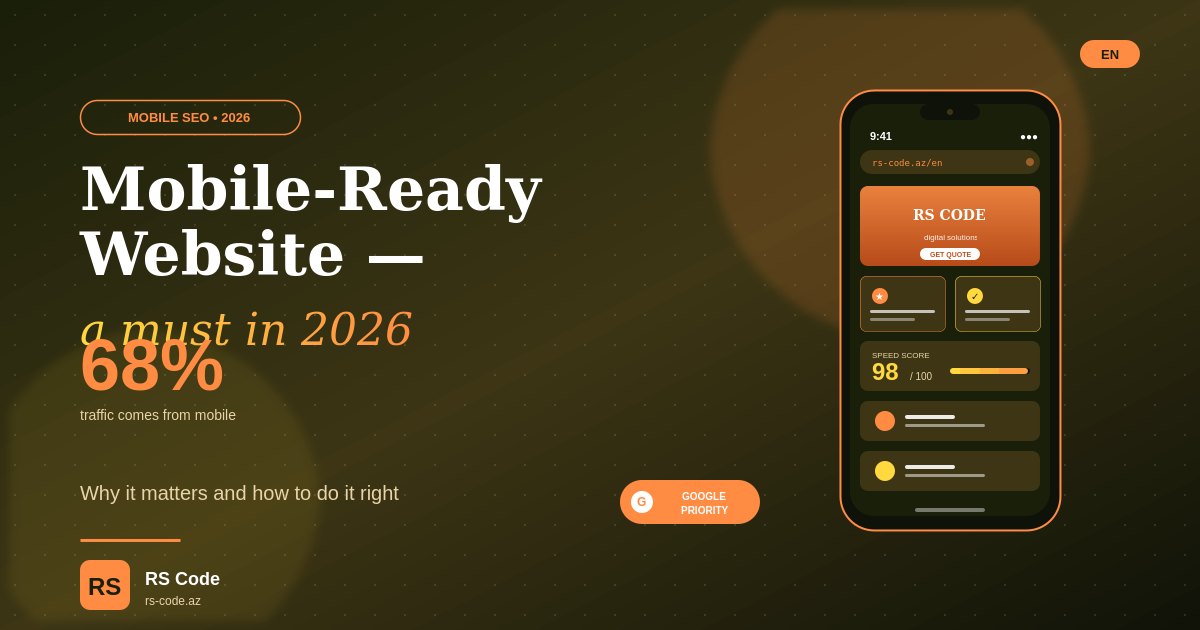
68% of internet users in Azerbaijan access websites via mobile devices. If your site isn't mobile-friendly, you're losing dozens of potential customers every day. This article explains why mobile-friendly design is now a must and how to do it right.
Pick up your phone and search for your website on Google. Click the first result — how does it look? Tiny text, buttons stuck together, images cut off at the edges? If yes, you're losing dozens of potential customers every single day.
In 2026, over 68% of internet users in Azerbaijan access websites from mobile devices. This means that if your site isn't mobile-friendly, 7 out of every 10 visitors will have a poor experience and go to your competitor. On top of that, since 2024 Google has been using "Mobile-First Indexing" — your search ranking is now determined by your mobile version, not your desktop one.
What is a mobile-friendly (responsive) website?
A mobile-friendly (responsive) site is one that works correctly on any device — computer, tablet, or phone. Text is readable, buttons are easy to tap with a finger, images adapt to the screen size automatically, and nothing gets cut off or glitches.
Important: a modern mobile-friendly site is not a separate "m.site.az" subdomain. That approach is outdated and Google now penalizes it. A real responsive site works on every device with a single URL and a single codebase.
7 key benefits of a mobile-friendly website
1. Better Google rankings
Google uses Mobile-First indexing. Your position in search results is determined by the quality of your mobile version. A non-responsive site simply won't show up.
2. More visitors, fewer bounces
Statistics show that if a mobile site takes more than 3 seconds to load, 53% of users leave immediately. A responsive site opens faster and keeps visitors engaged.
3. Higher conversion (more orders)
On a responsive site, "Order" and "Call" buttons are easy to tap. This typically increases leads and calls by 2-3 times.
4. Competitive edge
In Azerbaijan, many business sites are still not mobile-friendly. If yours delivers a smooth mobile experience, you have a direct advantage over competitors.
5. Cheaper advertising
Google Ads charges less per click for mobile-friendly sites (higher Quality Score). The same budget gets you more clicks.
6. Proper display on social media
When your link is shared on Instagram, WhatsApp, and Facebook, 90% of clicks come from mobile devices. A responsive site captures all that traffic.
7. Brand image
In 2026, a non-mobile-friendly site comes across as "outdated," "unreliable," and "unprofessional." This directly impacts sales.
How to check if your site is mobile-friendly
3 simple ways:
- Google PageSpeed Insights: go to pagespeed.web.dev, enter your site URL. You'll get separate mobile and desktop scores. If mobile is below 80 — there are problems.
- Google Mobile-Friendly Test: search.google.com/test/mobile-friendly. Google tells you directly whether your site is mobile-friendly.
- Check from your own phone: open the site on your phone. Do you need to zoom in? Are buttons hard to tap? Is the menu tiny? These are warning signs.
Important: if your site was built before 2020 and hasn't been updated, it's probably not mobile-friendly. Old sites used a separate "m.site.az" version — that approach is outdated and now penalized by Google.
How much does going mobile-friendly cost?
If your site is old and not responsive, you have two options:
- Adapt the existing site (400-1,200 AZN / ~$235-$705): suitable for small and mid-sized sites. Some design parts will need to be rebuilt.
- Build a new site (800-3,500 AZN / ~$470-$2,060): if the site is over 5 years old and the technical foundation is weak, starting fresh is more cost-effective. A new site will be mobile-friendly, SEO-optimized, and modern in design.
8 essential elements of a mobile-friendly site
- Speed: site should load in under 3 seconds
- Readable text: minimum 16px font size
- Large buttons: minimum 48×48px, easy to tap
- Easy navigation: hamburger menu or fixed bottom nav
- One-handed use: key buttons at the bottom of the screen
- Click-to-Call: tapping a number opens the dialer instantly
- Simple forms: minimum fields, autofill support
- Image optimization: WebP format, lazy loading
Frequently asked questions
My site is 5 years old and not mobile-friendly. Do I need a brand new one?
Not necessarily. If your site runs on WordPress or a similar CMS, adding responsive design takes 2-3 weeks and costs 400-1,000 AZN. But if the site is built on very outdated technology, rebuilding is more cost-effective.
Will going mobile-friendly slow my site down?
The opposite — a well-built responsive site is faster on mobile, because it uses images optimized for mobile devices and leaner code.
Does RS Code automatically build every site mobile-friendly?
Yes. Since 2019, all our projects follow the Mobile-First principle. We design the mobile version first, then adapt it for desktop. Every site must score at least 85+ on Google PageSpeed before delivery.
Is the mobile-friendly check free?
Yes. We'll audit your site at no cost, explain what's wrong, and recommend solutions. We only quote a price if our approach fits your needs.
Conclusion
A mobile-friendly website in 2026 is not a "nice-to-have" — it's a requirement for your business to stay digitally competitive. Your customers find you via mobile, Google ranks you via mobile, and your competitors are already moving in this direction.
To find out where your site stands, run the 3 tests above. If you spot a problem, contact the RS Code team. We'll do a free analysis and recommend the best solution for you.
📞 Phone: +994 77 582 99 89
📧 Email: info@rs-code.az