
Clopos, POSGroup, iiko, r_keeper — which POS system should you choose for a restaurant? Comparison table covering table management, KDS, waiter app, and delivery integration. A real 2026 guide for Azerbaijan restaurants.
Why Is a Restaurant POS Different from a Retail POS?
Restaurants have unique requirements: table management, order routing to the kitchen, half-portions, modifications, table merging, and split billing. Most POS systems designed for retail cannot handle these demands.
A POS system chosen for a restaurant must have at least these features:
- Table plan: See which tables are occupied, free, or waiting in real time
- KDS (Kitchen Display System): Orders go to a kitchen screen instead of paper tickets
- Waiter app: Staff take orders on a tablet or smartphone
- Modifications: Notes like "no soup", "extra cheese", "medium rare"
- Split billing: Guests at one table pay separately
- End-of-day report: Sales analysis by waiter, category, and table
- Delivery integration: Wolt, Bolt Food, and local platforms
Restaurant POS Systems in Azerbaijan: 2026 Comparison
| System | Monthly price | Table mgmt | KDS | Wolt/Bolt | Azerbaijani support |
|---|---|---|---|---|---|
| Clopos | ₼80–200 | ✓ Strong | ✓ Included | ✓ Yes | ✓ Yes |
| POSGroup | ₼50–150 | ✓ Basic | Add-on module | Limited | ✓ Yes |
| iiko | ₼200–500 | ✓ Strong | ✓ Included | ✓ Yes | RU/EN only |
| r_keeper | ₼250–600 | ✓ Strong | ✓ Included | Add-on | RU/EN only |
| Custom POS | — (₼3k–10k one-time) | ✓ Fully custom | ✓ Yes | Any platform | ✓ Azerbaijani |
7 Key Criteria When Choosing a Restaurant POS
1. Table management: An interactive floor plan lets you see table status, guest count, wait time, and bill total at a glance. Clopos leads in this area on the Azerbaijan market.
2. Kitchen Display System (KDS): Paper tickets slow down service and get lost. KDS sends orders directly to kitchen screens with color-coded priority — green for cold dishes, red for hot, yellow for overdue orders.
3. Waiter mobile app: Staff enter orders from a tablet or smartphone at the table, eliminating trips to a fixed terminal and reducing errors.
4. Delivery integration: In 2026, a significant share of Azerbaijan restaurant orders come via Wolt and Bolt Food. Without direct POS integration, orders must be entered twice, doubling the workload.
5. Inventory and recipe costing: Each item sold should automatically deduct ingredients from stock according to its recipe. This prevents waste, detects theft, and avoids "out of stock" surprises mid-service.
6. Offline mode: When the internet drops, your restaurant cannot stop. Your POS must work offline and sync data once connection is restored.
7. Local technical support: A POS failure at 8 PM on a Friday must be resolved in minutes, not hours. Local Azerbaijani support is a critical advantage over international systems.
Clopos vs POSGroup: Which to Choose?
| Feature | Clopos | POSGroup |
|---|---|---|
| Restaurant optimization | ✓ Strong (restaurant-focused) | Basic (universal system) |
| Table management | ✓ Interactive floor plan | Basic level |
| KDS support | ✓ Included | Paid add-on |
| Wolt/Bolt Food | ✓ Official integration | Limited |
| Monthly price | ₼80–200 | ₼50–150 |
| Pharmacy/retail | Not suitable | ✓ Suitable |
Bottom line: For restaurants, Clopos is the better fit. POSGroup is more universal for cafes, fast food, and retail.
Restopos: A Custom Restaurant POS from Azerbaijan
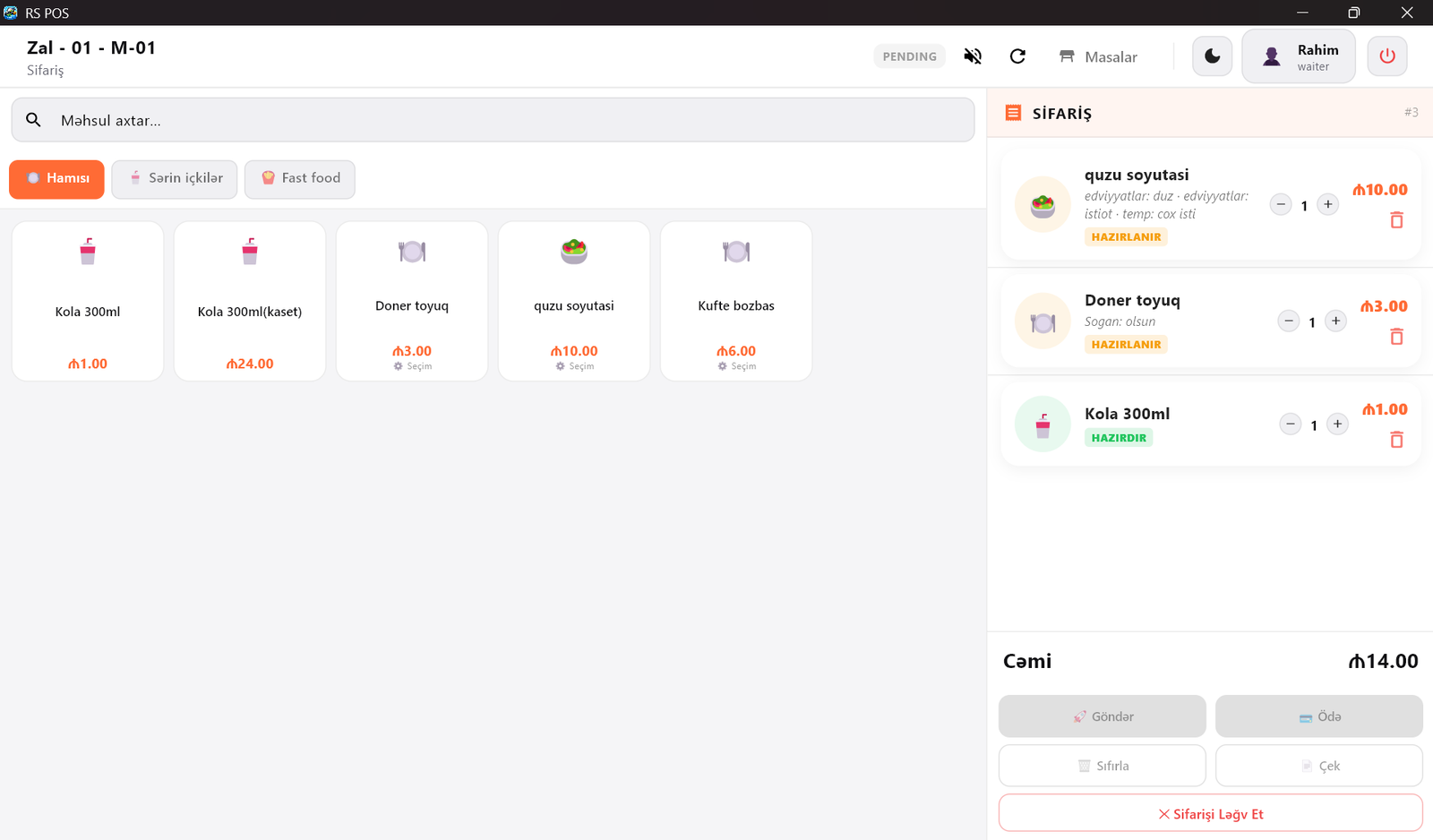
As the RS Code team, we built Restopos — a fully custom POS system for a restaurant chain in Ganja. No ready-made system covered their combination of needs: multiple dining rooms, both dine-in and delivery, and banquet service.
Restopos includes: room-by-room table plans, per-station KDS screens (cold kitchen, hot kitchen, bar), Android waiter app, delivery panel with courier dispatch and status tracking, banquet module with advance orders and deposits, recipe-based inventory deduction, and WhatsApp order confirmation.
The custom system paid for itself within 14 months.
Frequently Asked Questions
What is the best POS system for a restaurant in Azerbaijan?
In 2026, Clopos is the most suitable ready-made POS for restaurants in Azerbaijan — strong table management, KDS, Wolt/Bolt integration, and local Azerbaijani support. Restaurant chains with specific requirements benefit more from a custom-built POS system.
How much does a KDS (Kitchen Display System) cost?
In ready-made systems, KDS either requires an additional monthly fee (₼30–80/screen) or is bundled in a higher plan. The screen itself — an Android tablet or dedicated KDS monitor — costs ₼300–800. In custom POS systems, KDS is included from the start.
Are iiko and r_keeper suitable for Azerbaijan restaurants?
iiko and r_keeper are powerful international systems, but local support in Azerbaijan is limited — issues are handled through a local integrator, and response times can be slow. Monthly costs are 2–3× higher than Clopos. Recommended for high-volume restaurants with 10+ tables and complex operations.
What hardware does a restaurant POS system require?
Minimum: 1 cashier tablet (₼400–800), 1 thermal receipt printer (₼150–300), cash drawer (₼80–150). For KDS: a separate kitchen screen (₼300–600). For waiter app: a tablet per waiter (₼200–500). Total hardware for a small restaurant: ₼1,000–2,500.
Conclusion: Contact Us
The right POS for your restaurant depends on your menu size, number of branches, delivery model, and budget. For a small cafe, POSGroup is a perfect start. For a mid-to-large restaurant, Clopos is the optimal choice. If you need multiple rooms, custom inventory, or a banquet module — a custom POS is the smartest investment.
The RS Code team has experience with both ready-made POS setup and fully custom restaurant system development in Azerbaijan. Contact us for a free consultation — we will find the best solution for your restaurant together.